Summit Pest Protection provides bed bug thermal and chemical remediation across Sacramento County to halt biting infestations in residential living quarters without recurring long-term subscription mandates. Thermal…
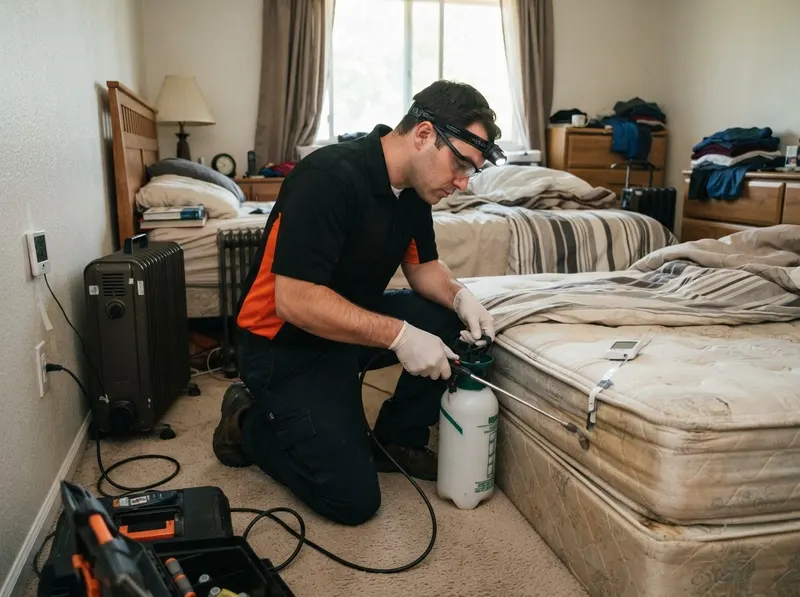
Summit Pest Protection provides bed bug thermal and chemical remediation across Sacramento County to halt biting infestations in residential living quarters without recurring long-term subscription mandates. Thermal remediation works by circulating heated air using industrial fans to elevate interior ambient temperatures between 120°F and 135°F, satisfying lethal thermal exposure metrics outlined by the U.S. Environmental Protection Agency. This convective heat penetrates interior wall voids, mattress seams, electrical conduits, and floorboard fissures where over-the-counter contact sprays cannot reach. To address bed bugs that attempt to harbor in structural cool spots near exterior foundations, technicians combine thermal heating with precision applications of insect growth regulators and desiccants approved by the California Department of Pesticide Regulation.
Single-room localized chemical treatments suit early-stage introductions detected within 14 days of travel or used furniture arrival, whereas full-structure thermal remediation is required for established, multi-room infestations spreading through contiguous framing. The technical trade-off centers on preparation intensity versus eradication certainty: chemical-only protocols demand multiple sequential visits spaced over 30 days to catch newly hatched nymphs, while convective heat eliminates all life stages, including desiccation-resistant eggs, in an 8-hour window. Homes throughout older architectural corridors like Midtown and Curtis Park frequently exhibit lath-and-plaster wall assemblies with deep settling cracks that harbor insects, making elevated heat penetration substantially more reliable than superficial dusting. Conversely, newer slab-on-grade developments in Natomas benefit from targeted perimeter crack-and-crevice placements alongside mechanical containment.
Effective structural preparation protects sensitive household belongings while maximizing air distribution. Residents must remove heat-sensitive items including aerosol cans, oil paintings, wax candles, vinyl records, and prescription medications prior to heat activation, adhering to safety thresholds established by the Consumer Product Safety Commission. Technicians position wireless thermal sensors throughout baseline trim, closet corners, and subfloor junctures, logging temperature milestones to ensure lethal thresholds persist continuously for at least 90 minutes. In multi-family dwellings near Oak Park or East Sacramento, technicians install physical isolation barriers across plumbing penetrations and shared walls to prevent horizontal movement into adjoining units, consistent with standards from the National Pest Management Association.
Technicians integrate physical exclusion alongside direct remediation to prevent re-infestation from exterior sources or shared structural framing. Exterior perimeter seals are applied around crawl space vents and entry thresholds to prevent cross-contamination from local wildlife or stray animal vectors, referencing guidance from the California Department of Public Health. Interior treatments avoid synthetic pyrethroid chemicals that cause behavioral avoidance and room-to-room scattering, utilizing instead advanced non-repellents evaluated by the UC Statewide Integrated Pest Management Program. Structural evaluations in Land Park and Pocket-Greenhaven homes also screen for attic microclimates that compromise chemical half-life, ensuring all applications align with structural safety guidelines from the Occupational Safety and Health Administration, the structural enclosure criteria of the National Institute of Standards and Technology, and municipal containment protocols maintained by the City of Sacramento.
Every job gets a firm, written price after a free on-site visit.
For standards, safe disposal, and service guidance on PEST CONTROL SEVICE in Sacramento, CA, useful references include U.S. EPA, ENERGY STAR, U.S. Dept. of Energy, Consumer.gov, U.S. Census Bureau, and Google Maps. General consumer and small-business resources are available from USA.gov, Better Business Bureau, FTC Consumer Advice, U.S. Small Business Administration, and Ready.gov.
Tell us about your bed bug thermal and chemical remediation job in Sacramento and we'll send a clear, written quote, usually the same day.
 Summit Pest Protection